If you have a choice, the triglyceride form of fish oil is preferable. The triglyceride form, i.e., 3 omega-3 fatty acids on a glycerol "backbone," is the form found in the body of fish that protects them from cold temperatures (i.e., they remain liquid at low ambient temperatures).
Most fish oils on the market are the ethyl ester form. This means that the omega-3 fatty acids have been removed from the glycerol backbone; the fatty acids are then reacted with ethanol to form the ethyl ester.
If the form is not specified on your fish oil bottle, it is likely ethyl ester, since the triglyceride form is more costly to process and most manufacturers therefore boast about it. Also, prescription Lovaza--nearly 20 times more costly than the most expensive fish oil triglyceride liquid on a milligram for milligram basis--is the ethyl ester form. That's not even factoring in reduced absorption of ethyl esters compared to triglyceride forms. Remember: FDA approval is not necessarily a stamp of superiority. It just means somebody had the money and ambition to pursue FDA approval. Period.
Taking any kind of fish oil, provided it is not overly oxidized (and thereby yields a smelly fish odor), is better than taking none at all. All fish oil will reduce triglycerides, accelerate clearance of postprandial (after-eating) lipoprotein byproducts of a meal (via activation of lipoprotein lipase), enhance endothelial responsiveness, reduce small LDL particles, and provide a physical stabilizing effect on atherosclerotic plaque.
But if you desire enhanced absorption and potentially lower dose to achieve equivalent RBC omega-3 levels, then triglyceride forms are better.
Here are cut-and-pasted abstracts of two of the studies comparing forms of fish oil.
Dyerberg J, Madsen P, Moller JM et al.
(0)
Biofeedback is a wonderful, natural way to gain control over multiple physiological phenomena, a means of tapping into your body’s internal resources. You can, for instance, use biofeedback to reduce anxiety, heart rate, and blood pressure, and achieve a sense of well-being that does not involve drugs, side-effects, or even much cost.
Biofeedback simply means that you are tracking some observable physiologic phenomenon—heart rate, skin temperature, blood pressure—and trying to consciously access control over it. One very successful method is that of bringing the beat-to-beat variation in heart rate into synchrony with the respiratory cycle. In day-to-day life, the heart beat is usually completely out of sync with respiration. Bring it into synchrony and interesting things happen: you experience a feeling of peace and calm, while many healthy phenomena develop.
A company called HeartMath has applied this principle through their personal computer-driven device that plugs into the USB port of your computer and monitors your heart rate with a device clipped on your earlobe. You then regulate breathing and follow the instructions provided and feedback is obtained on whether you are achieving synchrony, or what they call “coherence.” As the user becomes more effective in achieving coherence over time, positive physiological and emotional effects develop. HeartMath has been shown, for instance, to reduce systolic and diastolic blood pressure, morning cortisol levels (a stress hormone), and helps people deal with chronic pain. Downside of the HeartMath process: a $249 price tag for the earlobe-USB device.
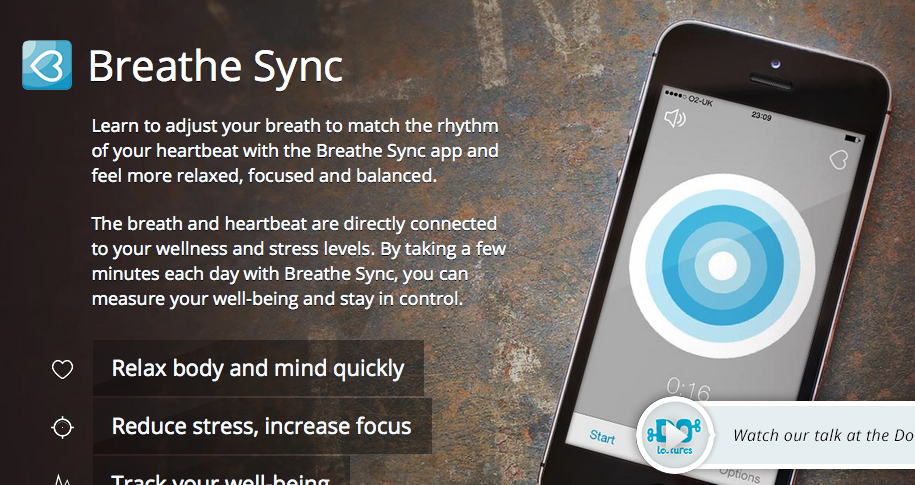
But this is the age of emerging smartphone apps, including those applied to health. Smartphone apps are perfect for health monitoring. They are especially changing how we engage in biofeedback. An app called Breathe Sync is available that tracks heart rate using the camera’s flash on the phone. By tracking heart rate and providing visual instruction on breathing pattern, the program generates a Wellness Quotient, WQ, similar to HeartMath’s coherence scoring system. Difference: Breathe Sync is portable and a heck of a lot less costly. I paid $9.99, more than I’ve paid for any other mainstream smartphone application, but a bargain compared to the HeartMath device cost.
One glitch is that you need to not be running any other programs in the background, such as your GPS, else you will have pauses in the Breathe Sync program, negating the value of your WQ. Beyond this, the app functions reliably and can help you achieve the health goals of biofeedback with so much less hassle and greater effectiveness than the older methods.
If you are looking for a biofeedback system that provides advantage in gaining control over metabolic health, while also providing a wonderful method of relaxation, Breathe Sync, I believe, is the go-to app right now.
“Looking over your medical record, Nancy, I’m a bit concerned about your risk for osteoporosis and hip fracture. It looks like your mom had a hip fracture at age 67. Is that right? ”
“Yes, she did,” Nancy responded. “And her life was never quite the same for the 15 years she lived after that.
“You’re 53 year old. Bone thinning develops over many years. Let’s get you scheduled for a bone scan.”
Two weeks later:
“Your z-score is 1.5, Nancy. This means you’ve got a mild form of osteoporosis called ‘osteopenia.’ Here: This is a prescription for alendronate, what used to be called Fosamax.”
“Aren’t there side-effects with that drug? A friend of mine said that her mom had a leg fracture from it.”
“Well, yes. All prescription drugs have potential side-effects. They’re rare, but they can happen and we can’t predict it. Besides leg fracture, there’s something called jaw osteonecrosis in which the jawbone dies and has to be surgically replaced. But would you rather run the risk of a hip fracture?”
“Before we jump to drugs, aren’t there natural things I could do first?”
(Big sigh.) “You can take calcium, but that only helps a bit. You’ve got to make a choice: Take the drug or risk a hip fracture.”
“I’m going to explore some natural remedies on my own first.”
Nancy’s dialogue with her doctor is fictional but based on similar encounters that occur thousands of times every day nationwide. Identify a problem, prescribe a drug. Natural remedies? “They don’t work.” “I don’t know anything about that.” “None of that is proven.” “I only practice evidence-based medicine.” You’ve probably heard a few of these explanations yourself if you ever question the wisdom of conventional medical care.
Each of Nancy’s fictitious interactions were no more 10 minutes long. If she is like most people, she will have one or two such interactions over the course of a year, unless she develops some acute illness. So she’s got something like 20-30 minutes per year to compress all of her “health” advice into the time allotted. 20-30 minutes per year to discuss bone health, nutrition, blood sugar issues, cholesterol issues, blood pressure, female issues, and all the other facets of health. Perhaps she has developed some chronic gastrointestinal complaints, too, and an odd rash on her elbows, maybe headaches a few times per week that she didn’t have before. Regardless, she’s going to have to make do with those few minutes, likely receiving one or more prescriptions or imaging procedures for each.
Such is the nature of modern healthcare: Provide the minimum interaction, address only a few, perhaps no more than one, problem, then prescribe a drug. This is, more often than not, wrong. Plain wrong. Tragically, awfully, unethically, unnecessarily wrong.
Let’s pick up again with Nancy. Upon learning of her osteopenia and long-term risk for hip fractures of the sort that changed her mom’s life and health irretrievably, Nancy started searching for solutions. Not only did she discover that, yes, there are indeed a number of safe and effective ways to deal with osteopenia. She also learned that such strategies have even been examined in clinical trials, some of the strategies pitted head-to-head with drugs and performed on a par, sometimes better, than prescription drugs. She also found that there are online communities that she could join and discuss her health situation with people all sharing the same health interests. During one such interaction at the start of her effort, when she was still a bit unsure and tentative, a woman she didn’t know but who shared a similar interest in restoring bone health, commented to Nancy, “Don’t sweat it, Nancy. I was in your shoes a little over a year ago. I followed a program for bone health: vitamin D, vitamin K2, magnesium, I made sure that I included leafy green vegetables at least once or twice per day, and I added strength training for a few minutes twice per week. I started with osteoporosis. My most recent bone density test showed that I reversed it completely—it’s entirely normal! So hang in there and be sure to share your questions and concerns with us here.”
THAT is what Cureality is all about. Cureality fills the gap of knowledge in health that is not being provided in a few minute-long medical interaction. Cureality reveals the astounding amount of credible, safe, scientific information that allows you to participate, sometimes take over completely, various aspects of health. You don’t have to fire your doctor; these efforts supplement the information and advice you obtain (or don’t obtain) in the doctor’s office. While critics may sometimes say that this can be dangerous or that misdiagnoses and dangerous treatments might be risked, our experience is the exact opposite: People do better by taking the reins of health themselves, choosing to use the health care system for acute or catastrophic illness—but not necessarily for health.
Our fictional woman, Nancy, returns to her doctor one year later after undergoing a repeat bone scan. The doctor opened her chart, clearly expecting to scold her for her foolhardy and careless attitude. Instead, he was speechless. After a pause, he said, “I don’t know how you did it, but your bone density is now normal, the density of a healthy 30-year old woman. Just continue doing what you’re doing.” He closed the chart and walked out.
Yes: “Just continue what you are doing”—not “Please tell me what you did so that I might learn something new,” or “Where did you learn about such strategies? I knew nothing about this!” Just “do what you’re doing.” Too often, that is the response you get that defines what modern health care has become.
You don’t want that kind of health care. Sure, it’s reassuring to know that the doctor and hospital are there in case you injure yourself or develop pneumonia. But obtain day-to-day health advice of the sort that keeps you slender, keeps blood pressure normal, maintains normal insulin and blood pressure responses, helps keep bowel health ideal, can even be used to reverse conditions such as autoimmune joint pain, diabetes, osteoporosis, or skin rashes, while costing next to nothing and yielding health care benefits for you and your family in multiple areas of health? That is the kind of health care you want.
That’s why we developed Cureality.
William Davis, MD
Author of #1 New York Times Bestseller Wheat Belly: Lose the wheat, lose the weight and find your path back to health, The Wheat Belly Cookbook, and Wheat Belly 30-Minute (or Less!) Cookbook published by Rodale, Inc.
Author, Track Your Plaque: The only heart disease prevention program that shows how the new CT heart scans can be used to detect, track, and control coronary plaque