sal following a course of unrelenting progression.
Randi and I, of course, both rejoiced with this unexpected success. But it raised some interesting questions: How important is Lp(a) when vitamin D is normalized and small LDL is not a part of the picture? How consistent with regression be with this strategy over time? Would normalization of vitamin D have stopped plaque from becoming established in the first place?
I hope these issues will clarify over time. For now, I'm thrilled with Randi's success. She remains on her present, "incomplete", though successful program.
Note: I would not ordinarily advise a young woman to undergo serial heart scanning with this frequency. Randi had unusual access to a scan center through a relationship with the staff. I am nonetheless grateful for the lessons her experience have taught us.
Whenever your doctor uses your cholesterol values--total, LDL, HDL, triglycerides--to judge your heart disease risk, he/she is trying to act as your fortune teller.
In some states, fortune telling is illegal, a misdemeanor. The New York State lawbooks say:
A person is guilty of fortune telling when, for a fee or compensation which he directly or indirectly solicits or receives, he claims or pretends to tell fortunes, or holds himself out as being able, by claimed or pretended use of occult powers, to answer questions or give advice on personal matters or to exorcise, influence or affect evil spirits or curses; except that this section does not apply to a person who engages in the aforedescribed conduct as part of a show or exhibition solely for the purpose of entertainment or amusement. (Source : Wikipedia)
Rather than occult powers, your physician claims to use "medical judgement" to tell your fortune. Except for that distinction, it might be construed as a misdemeanor.
Let's take three typical examples:
58-year old Laura has a high LDL of 195 mg/dl. Her HDL is 52 mg/dl, triglycerides 197 mg/dl. Does she have heart disease?
51-year old Jonathan has an LDL of 174 mg/dl, HDL 34 mg/dl, triglycerides 156 mg/dl. Does Jonathan have heart disease?
71-year old Marian has an LDL cholesterol of 135 mg/dl, HDL 84 mg/dl, triglycerides of 67 mg/dl.
None of the three have symptoms. They all feel well. Nobody is taking a statin cholesterol drug or other agent that would modify the numbers. Jonathan is around 30 lbs overweight. Nobody has an impressive family history of heart disease.
Can you tell who has heart disease and who doesn't? If you can, you're smarter than I am, because I certainly can't tell. But your doctor tries to divine your future by looking at these numbers.
Do they know something that we don't know? No. It's a crude odds game, a guessing game. A guessing game that frequently comes up on the losing end.
These are three real people. Laura, despite her high LDL, has no identifiable coronary heart disease. Jonathan has advanced coronary disease. These were his numbers just prior to his stent. Marian has a moderate quantity revealed by a CT heart scan score of 419.
Don't even try predicting your future from your cholesterol numbers--it simply can't be done. Every day, I see patients and physicians beating their heads over this dilemma. Telling your fortune using pretended occult powers is illegal. Telling your fortune using cholesterol numbers should be, too.
If you want to know if you have coronary plaque, that's the role of the CT heart scan. Plain and simple.
Matt was dumbfounded when he found out about his heart scan score of 317 in the summer of 2005.
Earlier that year he'd unintentionally lost 20 lbs. in the space of two months and was feeling awful. He was diagnosed with diabetes and put on several medications. He told me that the heart scan score was just adding insult to injury.
As you'd expect in someone with diabetes, Matt had a low HDL, increased triglycerides, and small LDL. Blood pressure and inflammation (C-reactive protein) were issues as well.
Matt's primary care physician had put him on a statin cholesterol drug as soon as he heard about Matt's heart scan score, so we kept this going. What Matt's primary care physician didn't know was that his "true" LDL had been much higher than the conventional calculated LDL had suggested, so the statin agent was a reasonable solution. (Matt was also not terribly motivated to make dramatic changes in lifestyle or food choices. The statin drug was a compromise.)
We added fish oil and vitamin D to his regimen. Though recent data have cast doubt on the value of treating homocysteine levels of around 12.5, Matt's much higher value of 28 was treated with vitamins B6, B12, and folic acid, with a resultant homocysteine of 7.6.
17 months into the Track Your Plaque approach, and Matt's repeat heart scan score: 244, a 23% reduction.
I was talking with a hospital nurse recently who told me about her lack of energy, blue moods, and other assorted complaints. At age 49, she was exasperated. So I suggested that she ask her gynecologist about progesterone cream.
The gynecologist advised her, "You don't have a uterus. You don't need progesterone." He went on to explain that the only reason to take progesterone was to prevent uterine cancer caused by estrogen.
Then what about progesterone's weight loss benefits? It's effects on increased energy, improved mood, deeper sleep? These benefits, of course, have nothing to do with the uterus.
I've witnessed these benefits in women many times, both in the peri-menopausal period (which starts around your late 30's) and menopause.
Why talk about progesterone when our focus is heart disease and reduction of heart scan scores? Because if progesterone in a woman helps her feel better, more upbeat, and accelerates weight loss, she's more likely to succeed in her plaque-control program.
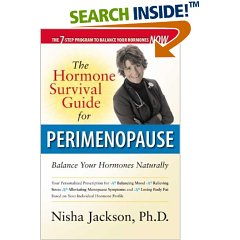
For additional comments on progesterone, read the Track Your Plaque interview with women's hormone expert, Dr. Nisha Jackson, Females, hormones, and weight control: An interview with Dr. Nisha Jackson found at http://www.cureality.com/library/fl_04-008njacksonhormones.asp. Dr. Jackson also has a book available called "The Hormone Survival Guide to Perimenopause".
Or, read Dr. John Lee's pioneering books, What Your Doctor May Not Tell You About Menopause: The Breakthrough Book on Natural Hormone Balance and What Your Doctor May Not Tell You About Premenopause: Balance Your Hormones and Your Life from Thirty to Fifty . (An edition that combines the two books is available, also.)