Evan spotted the kiosk set up in the middle of the local mall. "Free cholesterol screenings. Know your heart health!" the sign declared.
It was a free cholesterol screening being offered by a local hospital.
The friendly nurse behind the kiosk had Evan fill out a form, then pricked his finger. Five minutes later, she reported to him with a smile, "Sir, your cholesterol is 177--your heart's fine! We get concerned when cholesterol is over 200. So you're in a safe range."
What the nurse failed to recognize is that Evan's HDL was 30 mg, a low value that actually places him at high risk for heart disease. Low HDL also signifies high likelihood of the small LDL particle pattern, a marked predisposition towards pre-diabetes and diabetes, a probable over-reliance on processed carbohydrates in his diet, a dramatically increased probability of hidden inflammation (e.g., elevated C-reactive protein), increased tendency for high blood pressure. . .
In other words, Evan's "favorable" total cholesterol is, in truth, nonsense. It's misleading, falsely reassuring, and provided none of the insight that a real effort might have yielded. Like hippies, tie-dye, other relics of the 1960s, total cholesterol needs to be put to rest. It has served many people poorly and been responsible for countless deaths.
When you see a kiosk or other service like this, even if it's free, run the other way.
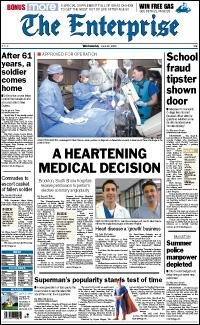
So announced a Boston newspaper recently, featuring a story about new heart program at a local hospital.
They were announcing how a hospital had entered the cardiovasculare procedure game and how it would boost their bottom line. The article discussed how the hospital administration was anticipating "a surge in patients from the baby boom generation."
To justify this new program, the article quoted an administrator from another hospital: "Cardiovascular issues is [sic] the number one cause people sought treatment at our hospital."
The hospital featured in the story had spent $13.5 million dollars to develop their program.
Do you think they'll make it back?
You bet they will--many times over. Hospitals are businesses, complete with a bottom line, an expectation of profit and an eye towards growth.
The hospitals in the city where I live (Milwaukee, Wisconsin) are, as in Boston and elsewhere, very aggressive--expanding into new territories, hiring new "salesmen" (physicians), all to capture more marketshare and produce more "product" (your coronary angioplasty, stent, bypass surgery, defibrillator, etc.).
The equation for hospital profits is tried and true. Ignore your heart disese risk and you can help your local hospital grow its business. Neglect to get your heart scan and you can help your hospital pay down its debt. Get a heart scan, then do nothing about it, and you may even justify a pay raise for the hospital administrators for record revenue growth and profit.
Hospitals are a growth business because of the failure of most people and their doctors to 1) identify hidden coronary disease (CT heart scan to obtain your heart scan score), then 2) seize control over it (the Track Your Plaque program or, at least, your doctor's guidance along with your efforts at prevention).
Unless you do so, you are highly likely to help your hospital boost its annual goal for procedures.
Despite an HDL cholesterol of 76 mg (spectacular!) and LDL of 82 mg, her CT heart scan showed a score of 135. At age 51, this placed her in the 90th percentile.
Not as bad, perhaps, as her Dad might have had, since he died at age 54 of a heart attack.
So we submitted blood for lipoprotein testing. Surprise! over 90% of all her LDL particles were small. (By NMR, they're called "small". By gel electropheresis, or the Berkeley Lab test, or VAP (Atherotech) technique, they're called "HDL3".)
What gives? Traditional teaching in the lipid world is that if HDL equals or exceeds 40 mg/dl, then small LDL will simply not be present.
Well, as you can see from Annie's experience, this is plain wrong. Yes, there is a graded, population-based effect--the lower your HDL, the greater the likelihood of small LDL. But small LDL is remarkably persistent and prevalent--regardless of your HDL.
We've seen small LDL even with HDLs in the 90's! I call small LDL the "cockroach" of lipids. If you think you have it, you probably do. Getting rid of small LDL requires a specific bug killer. (Track Your Plaque Members: Read Dr. Tara Dall's interview on small LDL.)
Don't let anybody blow off your request for lipoprotein testing just because your HDL is high. That's just not acceptable. Loads can be wrong even with a favorable HDL.
Katy had undergone a stress test while being seen in an emergency room, where she'd gone one weekend because of a dull pain on the right side of her chest. After her stress test proved normal, she was diagnosed (I believe correctly) with esophageal reflux, or regurgitation of stomach acid up the esophagus. She was prescrbed an acid-suppressing medication with complete relief.
But Katy also had coronary plaque. Three years ago, her CT heart scan score was 157. She'd made efforts to correct the multiple causes, though she still struggled with keeping weight down to gain full control over her small LDL particle pattern.
I felt it was time for a reassessment: another heart scan. After three years, without any preventive efforts, Katy's score would be expected to have reached 345! (That's 30% per year plaque growth.) It's a good idea to get feedback on just how much slowing you've accomplished.
But Katy declared, "But I didn't think another heart scan was necessary. My stress test was normal!"
What Katy was struggling to understand was that even at the time of her first scan, a stress test would have been normal. Plaque can be present with a normal stress test.
Plaque can even show explosive growth all while stress tests remain normal. Just ask former President, Bill Clinton, how much he should have relied on stress tests. (Mr. Clinton underwent annual stress nuclear tests. All were normal and he had no symptoms--all the way up 'til the time he needed urgent bypass surgery!)
Of course, at some point even a crude stress test will reveal abnormal results. But that's years into your disease and a lot closer to needing procedures and experiencing heart attack.
So, yes, Katy would benefit from another heart scan despite her normal stress test.
The message: Don't rely on stress tests to gauge whether or not plaque has grown, stabilized, or reversed. Stress tests can be used to gauge the safety of exercise, blood pressure response, and the potential for abnormal heart rhythms. Stress tests can be used as a method to determine whether blood flow in your coronary arteries is normal through an area with plaque.
But a stress test cannot be used to gauge whether plaque has grown. It's as simple as that. Gauging plaque growth requires a heart scan.
When I started practicing medicine around 20 years ago, it was common practice to alert a physician when their patient was seen in an emergency room.
If John Smith, for example, went to the emergency room with chest pain, the physician who had an established relationship with the patient--knew their history, had managed their health and illnesses, etc.--was notified, even if the hospital ER had no relationship with the physician. It was not uncommon for the patient to then be transferred to the hospital where their own doctor practiced.
Though cumbersome at times, it preserved the relationship of the patient with their doctor.
Over the past few years, this practice has crumbled. Nowadays, hospitals and their employed physicians (and other unscrupulous physicians acting in the name of profit) "fail" to notify the physician with an established relationship.
Guess what happens? The patient all too often ends up being put through the gamut of testing and procedures.
Why? For hospital profit, of course. If failure to notify a doctor who's had a 10-year long relationship with the patient is "overlooked" or, even more commonly, it's "unsafe" to transfer the patient because the patient is too "unstable" to be transferred, then this patient becomes ripe for picking--heart catheterization, stents, bypass surgery, etc. Ten's, if not hundreds, of thousands of dollars can be reaped by this deception. I call it "patient-napping".
I see this at least several times every month. As hospitals are becoming increasingly competitive, and as they put pressure on their physicians to churn patients for revenues, you're going to see more and more of this.
As always, what is your protection from this expanding influence of hospitals and the doctors too meek to stand up to them? Education and information. Arm yourself with an understanding of what is accomplished in hospitals, when you truly need them, and when you don't.
Take it one step further. At least from a heart disease standpoint--the #1 profit-maker for hospitals--aim to 1)identify your coronary plaque, then 2) seize control over your coronary plaque and reduce your risk for heart attack and heart procedures as much as humanly possible. That's the goal of the Track Your Plaque program.
A British Medical Journal study released in March, 2006 has prompted a media flurry of reports on the worthlessness of fish oil. (Hooper L, Thompson RL, Harrison RA et al. Risks and benefits of omega 3 fats for mortality, cardiovascular disease, and cancer: a systematic review. BMJ March,2006)
Don't believe it for a second.
First of all, the study was a re-analysis of the existing published scientific literature. It was not a new study. It included a wild conglomeration of different clinical observations, as the studies examining fish oil over the years have been extraordinarily heterogeneous--in populations examined, omega-3 supplement (e.g., fish vs. capsule), period of observation, endpoints measured.
The results were skewed by inclusion of a moderate-sized British study by Burr et al in men with angina. In this study, no benefit was demonstrated and, in fact, a negative effect--more heart attack and death--was observed with fish oil. This was not news, since the study was published in 2003. It's results have been a mystery to everyone, since its unexpected negative result for fish oil was so starkly different from virtually every other study that preceded it (suggesting a study flaw or statistical fluke).
Nonetheless, the Burr study served to throw off the overall analysis. It diluted the dramatic and persuasive outcome of the GISSI-Prevenzione Study of 11,000 people in which a 28% reduction in heart attack and 45% reduction in cardiovascular death was observed. Note that the substantial numbers of the GISSI make the study's outcome nearly unassailable.
Another important fact: fish oil is among the most powerful tools available to correct elevated triglycerides. Drops of 50% are common. Recall that triglycerides are a necessary ingredient to create the nasty LDL, as well as VLDL, Intermediate-density lipoprotein, and an undesirable shift from large to ineffective small HDL. Reducing triglycerides is therefore crucial for your plaque control program.
This re-analysis serves to prove nothing. Such analyses can only pose questions for further study in a real study like GISSI: a randomized (random participant assignment), controlled (treatment vs. placebo or other treatment) study.
The weight of evidence remains heavily in favor of fish oil, not only as helpful, but fabulously beneficial, particularly for anyone aiming to reduce coronary plaque.