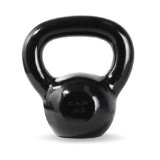
 You either love them or you hate them.
When you are in love with kettlebells, like I am, you enjoy the multi-muscle group movements. Kettlebell workouts are fluid, like a dance, putting together a chain of movements that leave your heart pounding and sweat pouring. Yes, there’s some sneaky cardio component to a kettlebell workout. A great blend of aerobic and anaerobic conditioning.
If you hate kettlebells it’s because kettlebell exercises keep you honest with proper exercise execution. Form is imperative to moves like the kettlebell swing or the kettlebell snatch. Do it incorrectly and you’ll be either sore or have bruised wrists the next day. But this is no reason to shy away from the kettlebell. You have way too much to gain from this odd looking piece of exercise equipment.

You will get a mega -caloric burn. The American council on Exercise states that the average kettlebell workout burns 20 calories per minute. That’s 1200 calories in just one hour. Kettlebell workouts utilize many muscle groups to give you an efficient, total body conditioning workout.
If you’re looking for a toned back side get a kettlebell. The classic kettlebell swing works all the posterior muscles like your glutes, hamstrings, and lower back. But only if you use correct form. Otherwise you'll find yourself with nagging back pain, instead of a better butt.
Kettlebell exercises are functional movements that will allow you to play hard without getting injured. If you are an athlete, a nature enthusiast, or just want to keep up with the kids then you need to give kettlebells a try. During a workout, the exercises will target movements that will make getting up and down off the floor easier, as well as bending over to pick something up.
If you are interested in doing kettlebell workouts
start with a coach or take class. You can’t fake form with kettlebell exercises or you could end up hurt. I’m not trying to scare anyone away because good form is easy to learn. Your body will memorize the correct movement pattern and you’ll be on your way to a successful kettlebell workout.
Though I have personally dealt with both auto-immune thyroiditis (Hashomoto’s) and several gut issues (wheat sensitivity, gastritis, etc.), it was not until recently that I discovered how close the thyroid and gut work together to keep you healthy – and how problems with one can affect the other along with your overall health.
Most of us understand that the primary function of the gut, that 25 to 30 feet of “tubing” that includes everything from your stomach to your large intestines, is to process the food we eat and allow the “good stuff” (essential nutrients) to pass into our blood stream while keeping the “bad stuff” (harmful proteins) out. However, it may surprise some that the gut also holds as much as 70% of all the immune tissue in the body.
Now, imagine all the health havoc that could ensue if, suddenly, the gut stopped doing its job – particularly if it failed to stop toxic proteins from entering the blood stream and then mounted an overzealous immune response against them. Sometimes, those overzealous immune responses reach beyond their intended targets to attack otherwise healthy tissues and organs – like the thyroid gland.
Recent studies indicate that thyroid hormones play a significant role in maintaining gut integrity, preventing leaky gut that can, in some cases, lead to auto-immune attacks against the thyroid. A properly functioning gut also aids the production of thyroid hormones by converting some of the inactive “T4” thyroid hormone into the functional “T3” hormone. Failure to simultaneously maintain both a healthy gut and a healthy thyroid can create a vicious cycle leading to chronic health problems and declining vitality.
What it all means is that to enjoy optimal health, you must promote good thyroid health to promote good gut health and vice versa. Unfortunately, traditional medicine tends to focus on one issue to the exclusion of others. A typical endocrinologist may treat your under active thyroid without spending a moment to address underlying gut issues. A gastroenterologist will work alleviate a gut problem but will rarely address a potential thyroid problem.
This illustrates, once again, how our bodies work as a system and why it is necessary to bridge the “healthcare gaps” in traditional medicine by becoming personally responsible for your health. I encourage everyone to consult the Cureality Program Guide and online
Cureality Diet and
Thyroid Health Tracks to learn more about how to optimize both your gut and thyroid health on your journey to realizing complete, whole-body health.